

End to end
From intake to funding — fully structured, fully controlled
Every client moves through a defined sequence with enforced entry conditions, real-time visibility, and underwriting-backed decision logic at each stage.
11 stages
The operational spine
Each stage has defined entry conditions, a named actor, and work the platform performs behind it.
Select any stage below
Lead capture
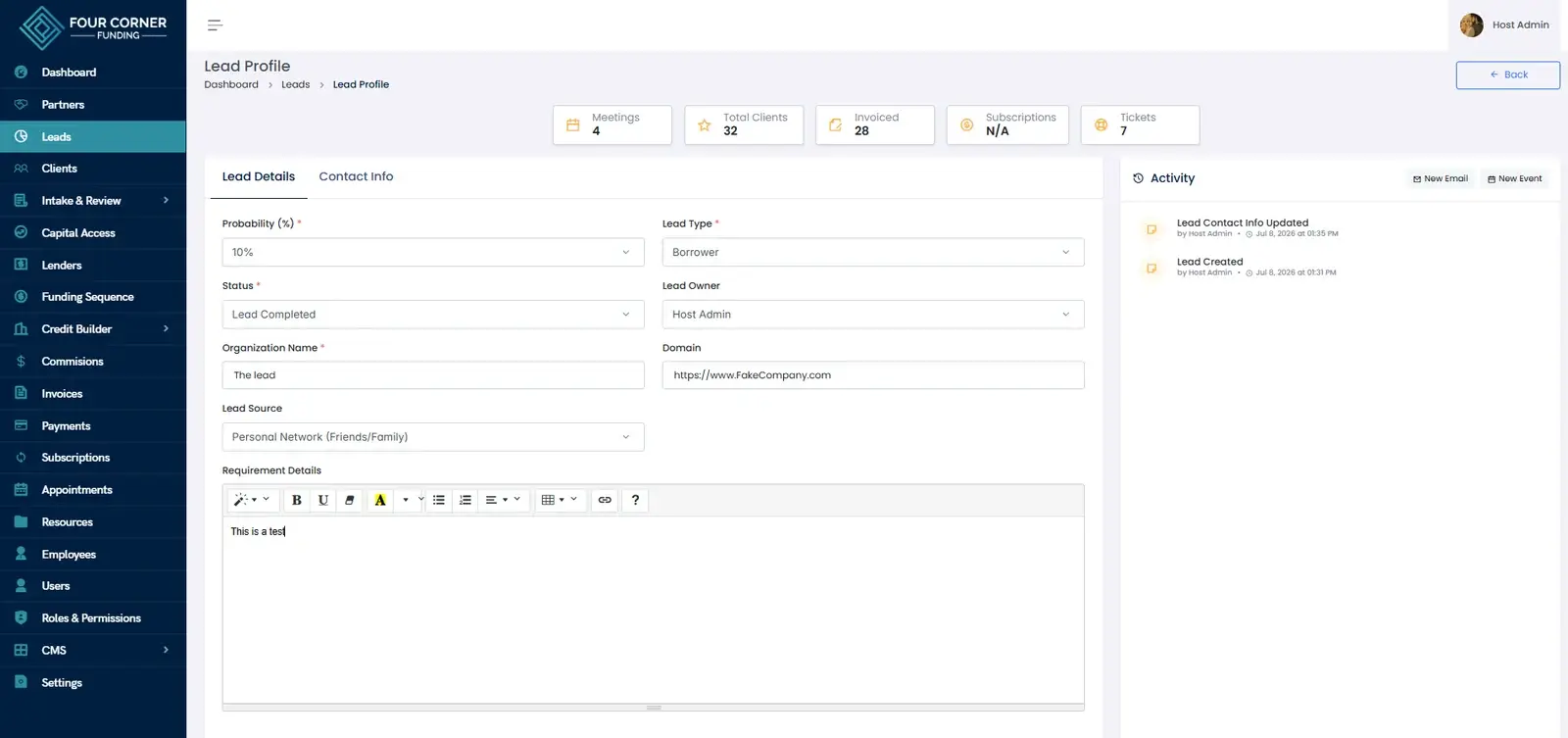
A partner adds a client, or the client enters through an approved intake path.
What the system does
- Creates the client profile
- Assigns the correct tenant
- Initializes lifecycle state
- Partner or client
A partner adds a client, or the client enters through an approved intake path.
What the system does
- Creates the client profile
- Assigns the correct tenant
- Initializes lifecycle state
Lead profile — Intake recordFour Corner Holdings platform · Synthetic demonstration data
Financing is subject to underwriting and program eligibility. Platform outputs support readiness evaluation and workflow; they are not guarantees of approval.
Client state
Client status is not a single metric
The platform tracks multiple system states at once — lifecycle, prequalification, credit tier, documents, conditions, deal position, and activity. Collapsing them into one number is how files get misread.
Tier is a credit-readiness indicator — not the client's overall status.
Lifecycle status
Where the client sits operationally
Prequalification status
Independent of lifecycle stage
Fundability / readiness
Score plus open blockers
Credit tier
Credit readiness only — not overall status
Document status
Required, received, verified, missing
Underwriting status
Queue position and path
Conditions status
Pending, satisfied, waived, failed
Funding / deal status
Pipeline position
Last activity
Recency signal across the book
Next required action
What unblocks the file now
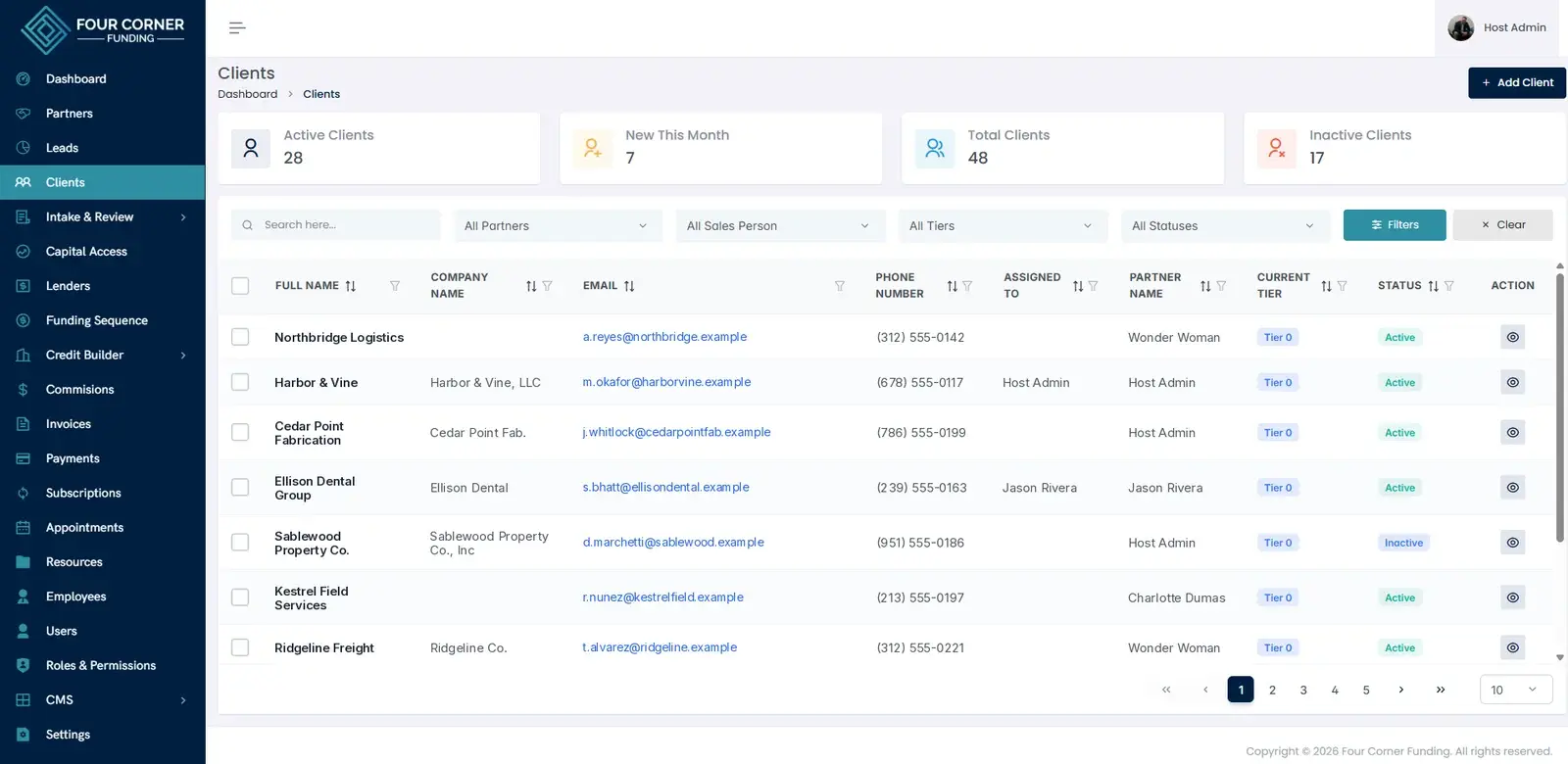
| Client | Lifecycle | Prequal | Tier | Documents | ||
|---|---|---|---|---|---|---|
| Northbridge LogisticsA. Reyes | Active | In review | Tier 2 | 6 of 8 verified | Upload Q2 bank statements | 2 hours ago |
| Harbor & Vine HospitalityM. Okafor | Underwriting | Submitted | Tier 3 | Complete | 2 open conditions | Yesterday |
| Cedar Point FabricationJ. Whitlock | Credit building | Not started | Tier 1 | 3 of 5 verified | Tier 2 gate: 2 accounts reporting | 3 days ago |
| Ellison Dental GroupS. Bhatt | Funded | Complete | Tier 3 | Complete | Roadmap phase 2 scheduled | 1 week ago |
| Sablewood Property Co.D. Marchetti | Onboarding | In progress | Tier 0 | 1 of 7 verified | Entity address mismatch flagged | 4 hours ago |
| Kestrel Field ServicesR. Nunez | Active | Conditional | Tier 2 | Complete | Awaiting structure review | Today |
- Tier 2
Northbridge Logistics
A. Reyes · 2 hours ago
ActiveIn review6 of 8 verifiedNext: Upload Q2 bank statements
- Tier 3
Harbor & Vine Hospitality
M. Okafor · Yesterday
UnderwritingSubmittedCompleteNext: 2 open conditions
- Tier 1
Cedar Point Fabrication
J. Whitlock · 3 days ago
Credit buildingNot started3 of 5 verifiedNext: Tier 2 gate: 2 accounts reporting
- Tier 3
Ellison Dental Group
S. Bhatt · 1 week ago
FundedCompleteCompleteNext: Roadmap phase 2 scheduled
- Tier 0
Sablewood Property Co.
D. Marchetti · 4 hours ago
OnboardingIn progress1 of 7 verifiedNext: Entity address mismatch flagged
- Tier 2
Kestrel Field Services
R. Nunez · Today
ActiveConditionalCompleteNext: Awaiting structure review
Boundaries
Partners work within the system, not around it
Partners have real operational authority over their book. They do not have authority over the rules that protect outcomes — and that separation is what makes results repeatable across a network.
What partners do
- Add and manage clients within their tenant
- Track lifecycle progress across the full book
- Monitor credit-builder stages and tier progression
- View funding readiness and deal status
- Work documents and conditions within permission scope
- Access training, resources, and notifications
What partners do not control
- Override underwriting decisions
- Skip required stages or gates
- Trigger unrestricted data or bureau pulls
- Bypass eligibility and sequencing logic
- Alter central underwriting rules
- See other tenants' clients or data
The platform protects outcomes by enforcing structure.
Control layer
The system enforces the process
Six places where the platform stops a file rather than letting it proceed into a predictable failure.
Tier gating blocks premature action
A client cannot apply into a stage they have not earned. The gate is evaluated against reporting evidence, not against intent.
Eligibility rules prevent avoidable declines
Account and vendor eligibility is scoped to current file state, so premature and duplicative applications never leave the platform.
Prequalification governs funding entry
Prequalification status is tracked independently of lifecycle status. A file can be operationally active and still not eligible to enter underwriting.
Documents must validate before progression
The Document Requirement Engine determines the needed set by file type. Unverified documents hold the file where it is.
Conditions hold the file until resolved
Pending and failed conditions block advancement. Waivers are recorded actions taken by authorized personnel, not silent overrides.
Sequencing conflicts surface before submission
Inquiry timing, utilization, and product-order conflicts are detected ahead of the application rather than diagnosed after the decline.
Catching a denial trigger before submission costs a conversation. Catching it afterward costs the file.
Next step
See the system in action
A full platform walkthrough covering the lifecycle end to end — where files move, where they stop, and why.
Financing is subject to underwriting and program eligibility. Platform outputs support readiness evaluation and workflow; they are not guarantees of approval.