Four Corner Holdings, LLC — Financial Technology Infrastructure
The Capital Intelligence Infrastructure Behind Four Corner Funding
A rule-driven, multi-tenant platform that connects business identity, fundability, business credit, underwriting, capital strategy, documentation, and funding workflows in one controlled system.
Four Corner Funding is the DBA and public operating brand of Four Corner Holdings, LLC.
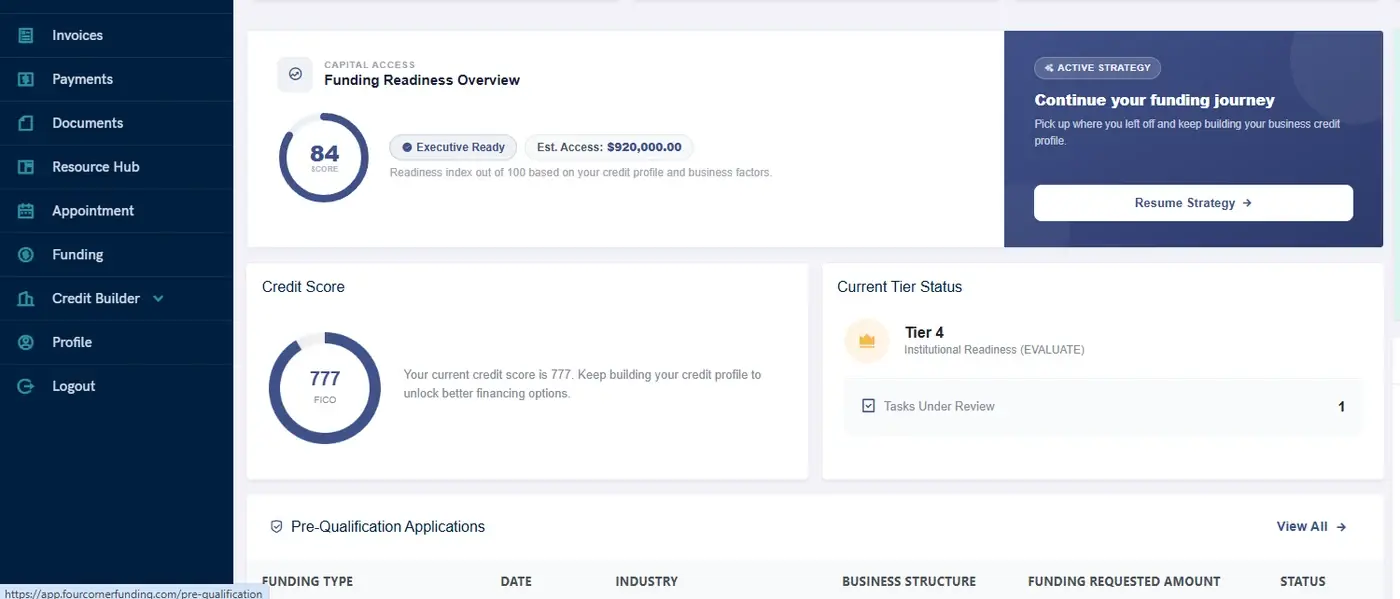
Readiness score
Not a credit decision
- Business identity consistency92
All records aligned
- Entity and compliance structure78
Registered agent record stale
- Documentation completeness64
2 required documents outstanding
- Business credit profile71
3 accounts reporting, 1 pending
- Operating and deposit history88
12 months verified
- Utilization and sequencing risk41
Inquiry timing conflict detected
Next required action
Inquiry timing conflict detected. Two applications are sequenced inside the same reporting window — resolve before proceeding.
Rule-driven intelligence
Engine logic, not manual judgment
Multi-tenant architecture
Isolated environments per organization
Controlled data access
Approved workflows on defined cycles
Real-time lifecycle visibility
Ten state dimensions, one view
The relationship
Holdings builds it. Funding operates it.
One company writes the software. The other runs on it. Understanding which is which is the fastest way to understand what you are looking at.
Four Corner Holdings, LLC
The financial-technology company. It designs, owns, and operates the capital intelligence platform — the engines, the workflow rules, the tenant architecture, and the underwriting logic that governs every file.
Four Corner Funding
The public financial-services DBA. It is the real-world operating environment where the platform runs every day — not a separate company that built the software.
Why it matters: the platform was not built in a vacuum and then sold. It was built inside an operating funding business, against real workflow, and then generalized so other qualified operators could run on the same infrastructure.
Platform structure
Five pillars, seventeen engines, one system
The engines are not features bolted together. Each pillar owns a stage of the capital problem, and each engine's output becomes the next one's input.
- 01
Business Identity and Fundability
Before capital is a question, the business itself has to hold up to review. This pillar establishes whether the entity is structurally sound, consistently represented, and documented well enough to underwrite.
- 02
Business Credit Development
Business credit is built through sequence and evidence, not enthusiasm. This pillar governs what a client is permitted to do next and requires verified reporting before advancement.
- 03
Underwriting and Intelligence
Structured evaluation applied consistently to every file. The platform assembles data, documents, calculations, risk factors, and conditions into a reviewable package under authorized human control.
- 04
Capital Optimization
Capacity, structure, and timing evaluated together. The objective is an appropriate capital structure — not the largest available number.
- 05
Growth and Opportunity
The file does not end at funding. This pillar governs what happens next and keeps the client's history working in their favor.
- See every engine
17
engines in the connected system
Every engine reads shared file state and writes back to it. There is no export step, no re-keying, and no version of the truth that lives in someone's spreadsheet.
The engine ecosystem
Full breakdown →Business Identity and Fundability
Business Credit Development
Underwriting and Intelligence
Capital Optimization
Growth and Opportunity
Architecture
Built on true multi-tenant infrastructure
Each partner, organization, and borrower operates inside a controlled environment. Data is isolated, permissions are enforced at the system level, and visibility is governed by role rather than preference.
- Tenant isolation
- No data crossover between organizations
- Role-based access control
- Scope defined by role, not request
- Controlled API middleware
- Third-party data on approved paths
- Least privilege by design
- The default is the narrower scope
FCH global administration
Owns the rulesSystem-level authority. Underwriting logic, engine configuration, and platform governance live here and are not editable downstream.
White-label tenant
Owns its environmentBranding, domain, internal teams, its own clients, and billing within assigned permissions. Cannot see other tenants or alter central underwriting logic.
Certified Partner
Owns its bookIts own clients, pipeline, readiness, documents, and conditions within permission scope. Cannot override underwriting or skip gates.
Borrower / client
Owns its fileIts own state, documents, tier progression, and next required action. Cannot trigger data pulls, select capital sources, or bypass sequencing.
Visibility flows downward and never sideways. A tenant cannot see another tenant, a partner cannot see outside its book, and a borrower sees only its own file. Access is defined by role — not by preference or request.
End to end
From lead capture to post-funding roadmap
Eleven stages, each with defined entry conditions. The platform decides what happens next based on file state — not on who is most confident in the room.
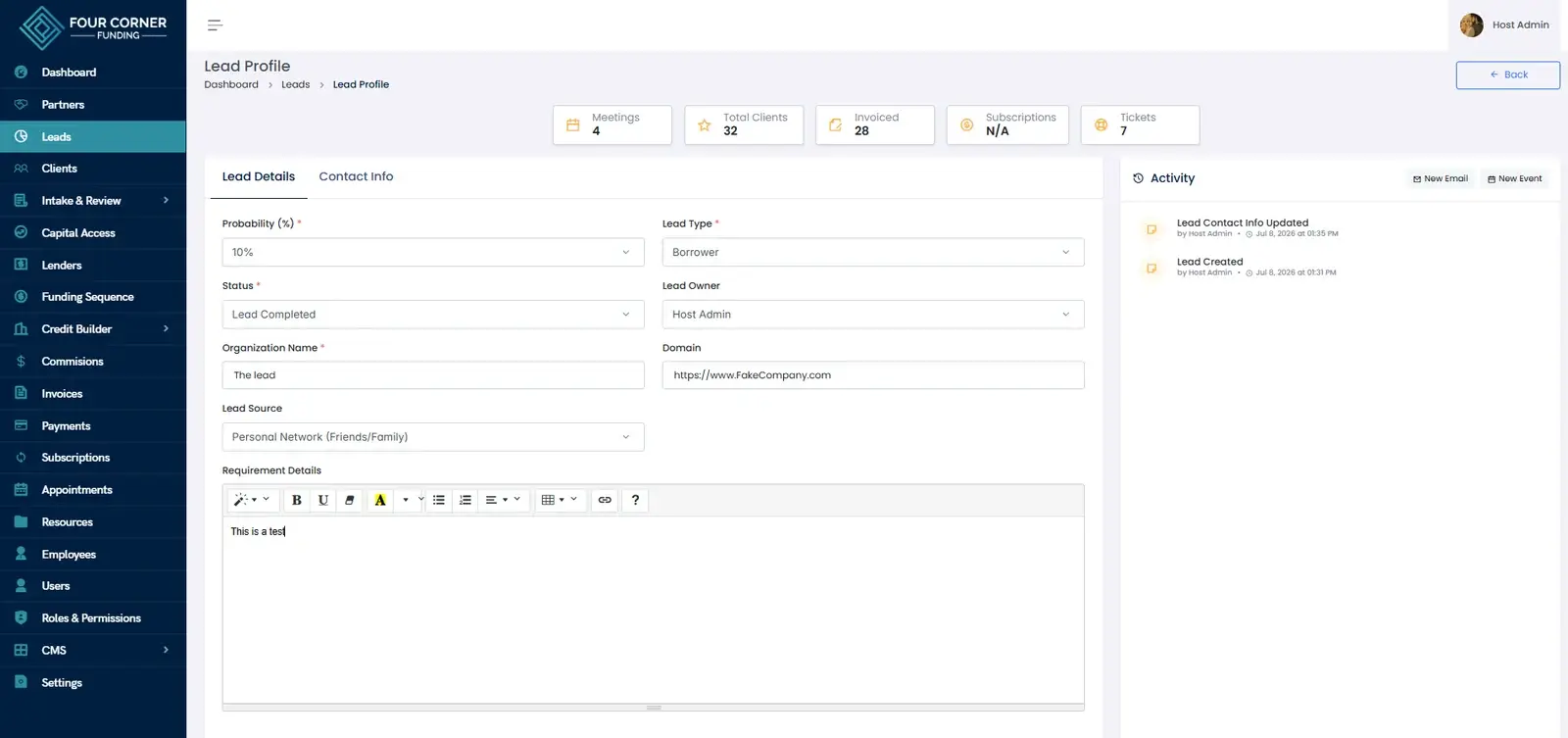
Lead capture
A partner adds a client, or the client enters through an approved intake path.
What the system does
- Creates the client profile
- Assigns the correct tenant
- Initializes lifecycle state

- Partner or client
A partner adds a client, or the client enters through an approved intake path.
What the system does
- Creates the client profile
- Assigns the correct tenant
- Initializes lifecycle state
Lead profile — Intake record
Four Corner Funding platform · Synthetic demonstration data
Platform outputs support readiness evaluation and workflow. They are not credit decisions and are not guarantees of approval.
Client state
Client status is not a single metric
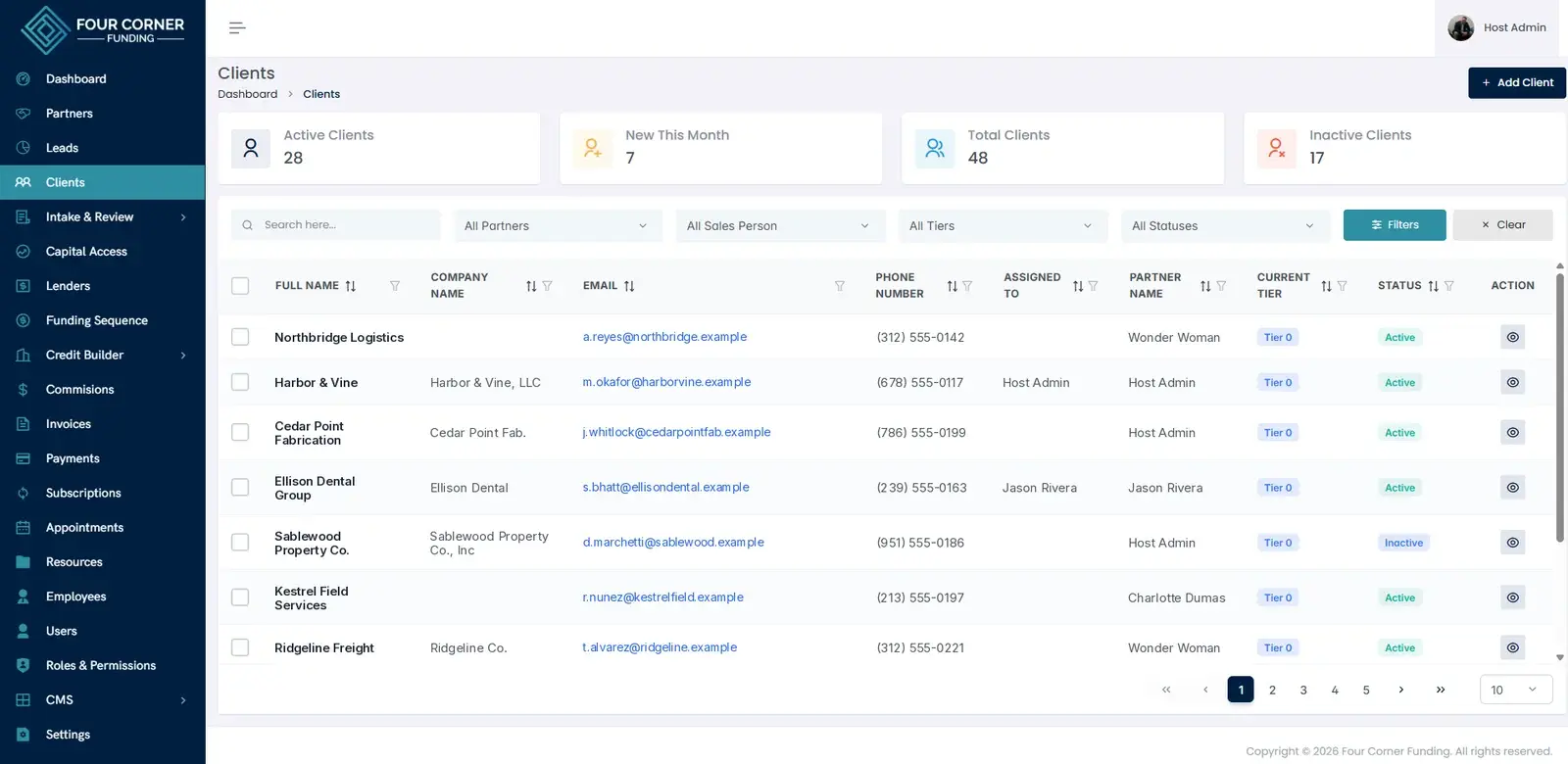
The platform tracks ten dimensions of client state simultaneously. A partner opening the dashboard sees the whole file — not a tier number standing in for everything else.
Tier is a credit-readiness indicator — not the client's overall status.
Lifecycle status
Where the client sits operationally
Prequalification status
Independent of lifecycle stage
Fundability / readiness
Score plus open blockers
Credit tier
Credit readiness only — not overall status
Document status
Required, received, verified, missing
Underwriting status
Queue position and path
Conditions status
Pending, satisfied, waived, failed
Funding / deal status
Pipeline position
Last activity
Recency signal across the book
Next required action
What unblocks the file now
| Client | Lifecycle | Prequal | Tier | Documents | ||
|---|---|---|---|---|---|---|
| Northbridge LogisticsA. Reyes | Active | In review | Tier 2 | 6 of 8 verified | Upload Q2 bank statements | 2 hours ago |
| Harbor & Vine HospitalityM. Okafor | Underwriting | Submitted | Tier 3 | Complete | 2 open conditions | Yesterday |
| Cedar Point FabricationJ. Whitlock | Credit building | Not started | Tier 1 | 3 of 5 verified | Tier 2 gate: 2 accounts reporting | 3 days ago |
| Ellison Dental GroupS. Bhatt | Funded | Complete | Tier 3 | Complete | Roadmap phase 2 scheduled | 1 week ago |
| Sablewood Property Co.D. Marchetti | Onboarding | In progress | Tier 0 | 1 of 7 verified | Entity address mismatch flagged | 4 hours ago |
| Kestrel Field ServicesR. Nunez | Active | Conditional | Tier 2 | Complete | Awaiting structure review | Today |
- Tier 2
Northbridge Logistics
A. Reyes · 2 hours ago
ActiveIn review6 of 8 verifiedNext: Upload Q2 bank statements
- Tier 3
Harbor & Vine Hospitality
M. Okafor · Yesterday
UnderwritingSubmittedCompleteNext: 2 open conditions
- Tier 1
Cedar Point Fabrication
J. Whitlock · 3 days ago
Credit buildingNot started3 of 5 verifiedNext: Tier 2 gate: 2 accounts reporting
- Tier 3
Ellison Dental Group
S. Bhatt · 1 week ago
FundedCompleteCompleteNext: Roadmap phase 2 scheduled
- Tier 0
Sablewood Property Co.
D. Marchetti · 4 hours ago
OnboardingIn progress1 of 7 verifiedNext: Entity address mismatch flagged
- Tier 2
Kestrel Field Services
R. Nunez · Today
ActiveConditionalCompleteNext: Awaiting structure review
Who operates here
Access structured around how you work
There are exactly two public partner models, plus internal enterprise deployment. Each maps to a different level of control over the environment.
Certified Partner
Professionals managing clients directly inside the platform, with full lifecycle visibility and structured workflows.
View partner accessWhite-Label Partner
Organizations operating their own branded, tenant-isolated deployment — with central underwriting logic intact.
View white-label modelEnterprise and internal teams
Underwriting operations, funding operations, document control, and administrative oversight across teams.
View enterprise use cases
The difference
Fragmented tools versus a unified operating system
The problem in this category is rarely a missing feature. It is that the pieces do not know about each other, so nothing can be enforced across them.
What fragmentation costs
Guidance without enforcement
Clients take actions out of sequence, and the denial arrives before anyone notices the ordering was wrong.
Account lists with no eligibility control
Premature and duplicative applications generate avoidable declines and inquiry damage.
Manual underwriting judgment
The same file gets different treatment depending on who reviews it and how busy they are.
Single-metric client tracking
Tier gets reported as overall status, so operators act on an incomplete picture of the file.
Disconnected CRM, documents, and funding tools
Data fragments across systems and reconciliation becomes the job instead of the work.
What integration makes possible
One operating system, not layered tools
Every module runs inside a single architecture with shared state. There is no reconciliation step, because there is nothing to reconcile.
Rule-driven engines
Actions are governed by system logic evaluated against file state — not by the confidence of whoever is at the keyboard.
Full lifecycle visibility
Clients are tracked across ten simultaneous state dimensions. Tier is one of them, and only one.
Underwriting built in
Files are assembled, conditioned, and packaged inside the platform under authorized human control before they move.
Tenant-based architecture
Partners, white-label organizations, and borrowers operate in isolated environments with role-scoped visibility.
Comparison categories describe common patterns in disconnected tools, coaching programs, and manual broker workflows. Capabilities vary by provider. This is not a claim about any specific named company.
Platform walkthrough
Watch the system operate
A structured walkthrough of the borrower experience, the partner dashboard, underwriting and conditions, and the funding pipeline — narrated as a product demonstration, not a marketing reel.
- 01Borrower onboarding
- 02Fundability and identity
- 03Tier progression
- 04Partner dashboard
- 05Underwriting and conditions
- 06Funding pipeline
Next step
See how the platform actually works
A structured walkthrough of the architecture, the engines, and how you would operate inside the system. We qualify first so the session is worth your time.
Financing is subject to underwriting and program eligibility. Platform outputs support readiness evaluation and workflow; they are not guarantees of approval.