


Licensing and Compliance
Which States Actually License Business Loan Brokers
Most states do not have a business loan broker license. A handful do, and a second group regulates brokers through rules that never use the word broker.
5 min read
Operator guide
A commercial finance company needs four things: clients who trust you, a compliant structure, funding-source access, and systems to run files. Most people underestimate the last two. Here is what each takes, and where a white-label platform fits.
The relationships are the hardest part to acquire, and many professionals already have them. The work that stops most new funding companies is operational: settling licensing before the first file, getting funding-source access, and keeping documents, review, and status under control once files start arriving.
The sequence below is the order we would work in. It is general information, not legal advice.
Business owners who already trust you with their numbers. This is the part no platform can supply.
Entity, licensing where required, fee structure, and client agreements appropriate to the states and products you choose.
Portal, CRM, document control, readiness evaluation, underwriting workflow, funding pipeline, business credit, and training.
Step by step
Each step links to a longer Insights post where the detail matters.
Pick the clients you already have access to and the products they need: working capital, lines of credit, equipment, revenue-based financing, SBA, commercial real estate. Products are regulated differently, so this choice shapes every step after it.
Licensing generally follows where the borrower is, what the product is, who funds it, and what you actually do on the file. Most states do not license commercial brokers; several do. Map your states and products first, then take the ambiguous ones to counsel.
Upfront fees to obtain financing are restricted in a number of states and draw scrutiny in most others. Separately, a growing list of states requires standardized cost disclosures on commercial financing offers. Build both into how you work from the first file.
Direct relationships are negotiated one at a time, and every ISO or broker agreement carries commitments worth reading closely. A platform with an established funding-source network shortens this step considerably.
Once files arrive, the document chase, inconsistent review, and scattered status become the bottleneck. Many independent operations hit a ceiling at around a dozen live files for exactly this reason.
The fastest first clients come from relationships you already hold: accounting clients, credit clients, consulting clients, referral partners. Buying leads before you can run files well is the expensive way to learn.
In commercial finance, the renewal and the next capital need are where most of the value sits. Keep the relationship, the history, and the next step inside your own business.
General information, not legal, tax, or financial advice. Licensing and fee rules change; confirm current requirements with counsel licensed in the states you serve.
Where a platform fits
The operational layer that usually takes years to assemble.
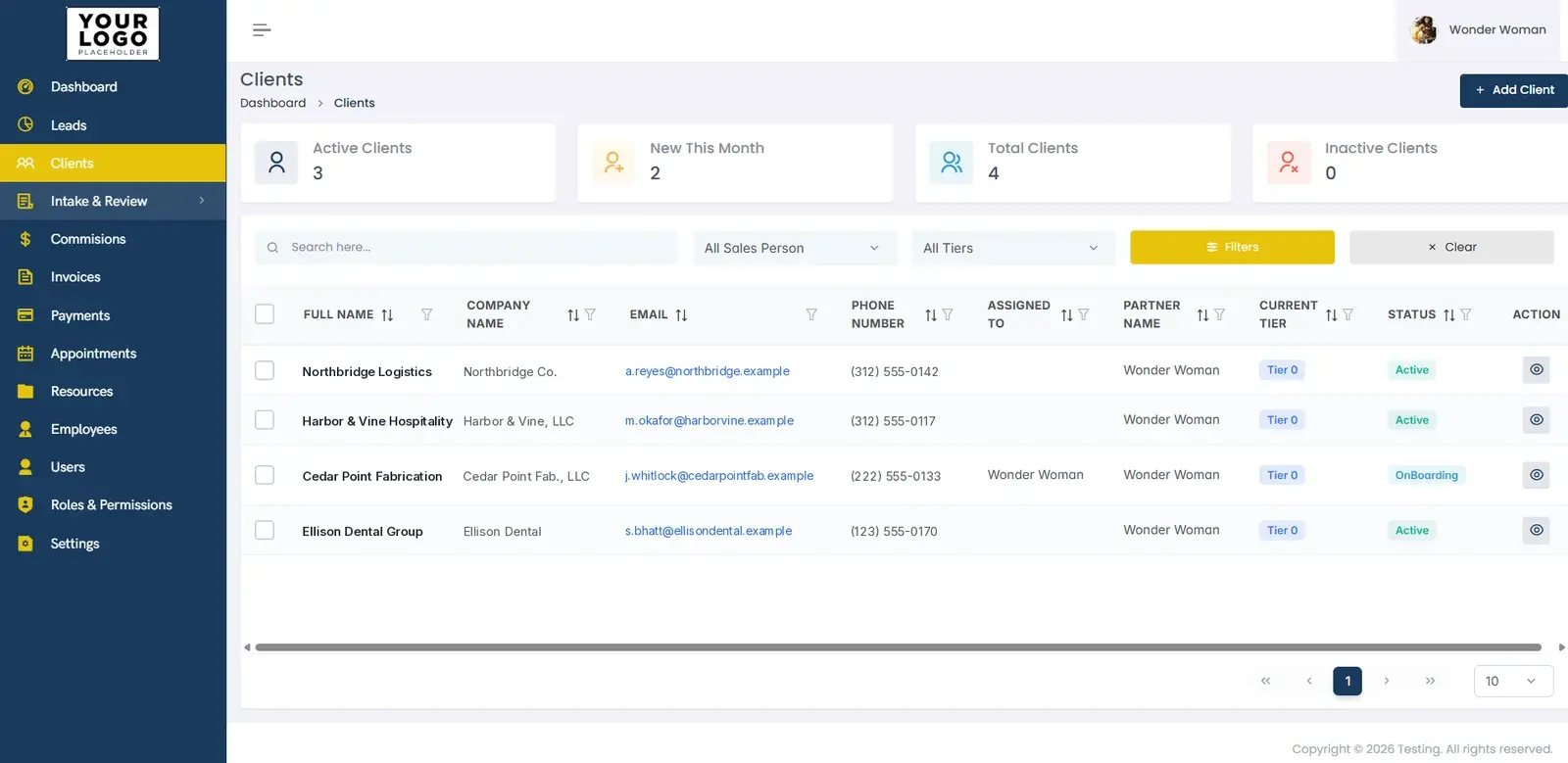
A partner's client list
Each client shows lifecycle, prequalification, documents, and the next required action. The platform tells you what unblocks each file, so a growing book does not become a growing inbox.
Three ways to start
Each can work. They differ in how long it takes to fund the first file and what you maintain afterwards.
Time to first funded file
Software to maintain
Funding-source access
Consistent file treatment
Your brand in front of clients
Anyone considering a commercial finance business, from scratch or alongside an existing practice.
It varies widely with how much you build yourself, which states and products you choose, and whether licensing or bonding applies. Building your own software is by far the largest cost; running on a white-label platform removes it. Platform terms are discussed on a walkthrough rather than published.
Possibly. It depends on the borrower's state, the product, the funder, and what you do on each file. Most states do not license commercial finance brokers, but several do, and a few regulate brokers through laws that never use the word. Speak with counsel licensed in the states you plan to serve.
Many partners do exactly that. CPAs, credit professionals, and consultants add commercial finance as a service line for clients they already serve. Professionals in regulated fields should confirm it is consistent with their own licensing and firm requirements.
No. Financing is originated and underwritten by independent third-party funding sources, which make every credit decision. Four Corner Holdings provides the technology platform.
Insights
Writing on licensing and compliance, for people who run funding operations.
Most states do not have a business loan broker license. A handful do, and a second group regulates brokers through rules that never use the word broker.

Ten states now require written cost disclosures on commercial financing. Several reach brokers directly, and one has a registration deadline in December 2026.

The commission split is the part everyone reads. The clauses that decide whether the relationship is survivable are usually further down.
Next step
A call or Zoom walkthrough of how partners set up, what the platform provides, and what you would settle on your side first.
Four Corner Holdings, LLC is not a bank, lender, broker-dealer, or financial institution and does not make credit decisions. Platform outputs support readiness evaluation and workflow. They are not credit decisions and are not guarantees of approval.