
The Document Chase Is Where Deals Die
Most files never get declined. They stall between "interested" and "submitted" because nobody could say exactly what was still missing.
If you tracked where funding files actually go to die, underwriting would not top the list. The biggest loss happens earlier, in the stretch between a client saying yes, let's do this and a complete file reaching a funding source.
That stretch is the document chase. It is unglamorous, it is repetitive, and it is where most operators quietly lose a third of their pipeline.
Why it goes wrong
The chase rarely fails because a client refuses to send documents. It fails because of ambiguity.
The broker sends an email: can you send over your bank statements and a few other things? The client sends two months of statements as phone photos. The broker asks for the third month, and the voided check, and the EIN letter. The client sends the voided check. A week passes. Nobody is sure what is still outstanding — including the broker.
Every round of can you also send costs a day or two, and each one drains a little more urgency out of the deal. By the fourth round, the client has either found capital somewhere else or decided it is not worth the hassle.
Make the list exact, and make it visible
The fix is not more reminders. It is removing the ambiguity entirely.
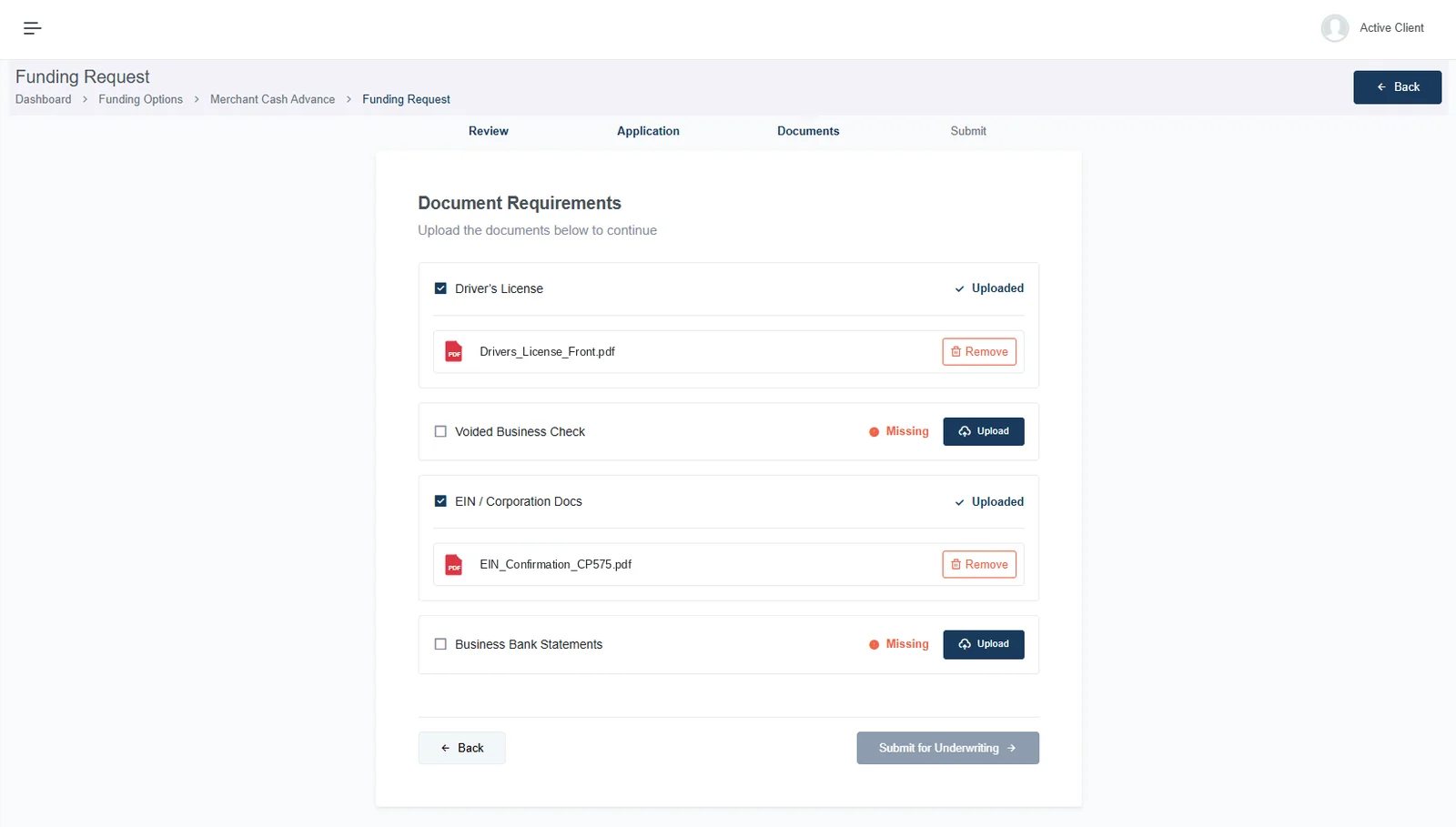
Look at what that screen does:
- It names every required document. Not "a few other things" — four specific items.
- It shows the state of each one. Uploaded or missing, at a glance.
- It puts the upload button right next to the gap. No hunting for the email with the link.
- It holds submission until the list is complete. The submit button stays greyed out while anything is missing, so an incomplete file cannot go out by accident.
The most important thing about it is who is looking at it. This is the client's view. They do not have to wait for the broker to tell them what is outstanding — they can see it themselves, and finish it themselves, at eleven at night when they finally have a minute.
The list depends on the product
Notice the breadcrumb at the top of that screen: Funding Options → Merchant Cash Advance → Funding Request. The four documents on that list are the ones that product needs.
That matters more than it looks. Different financing asks for different things. A working capital advance leans on bank statements. Equipment financing needs the invoice or quote for the equipment. Receivables financing needs an aging report. A term loan may want tax returns and a business plan.
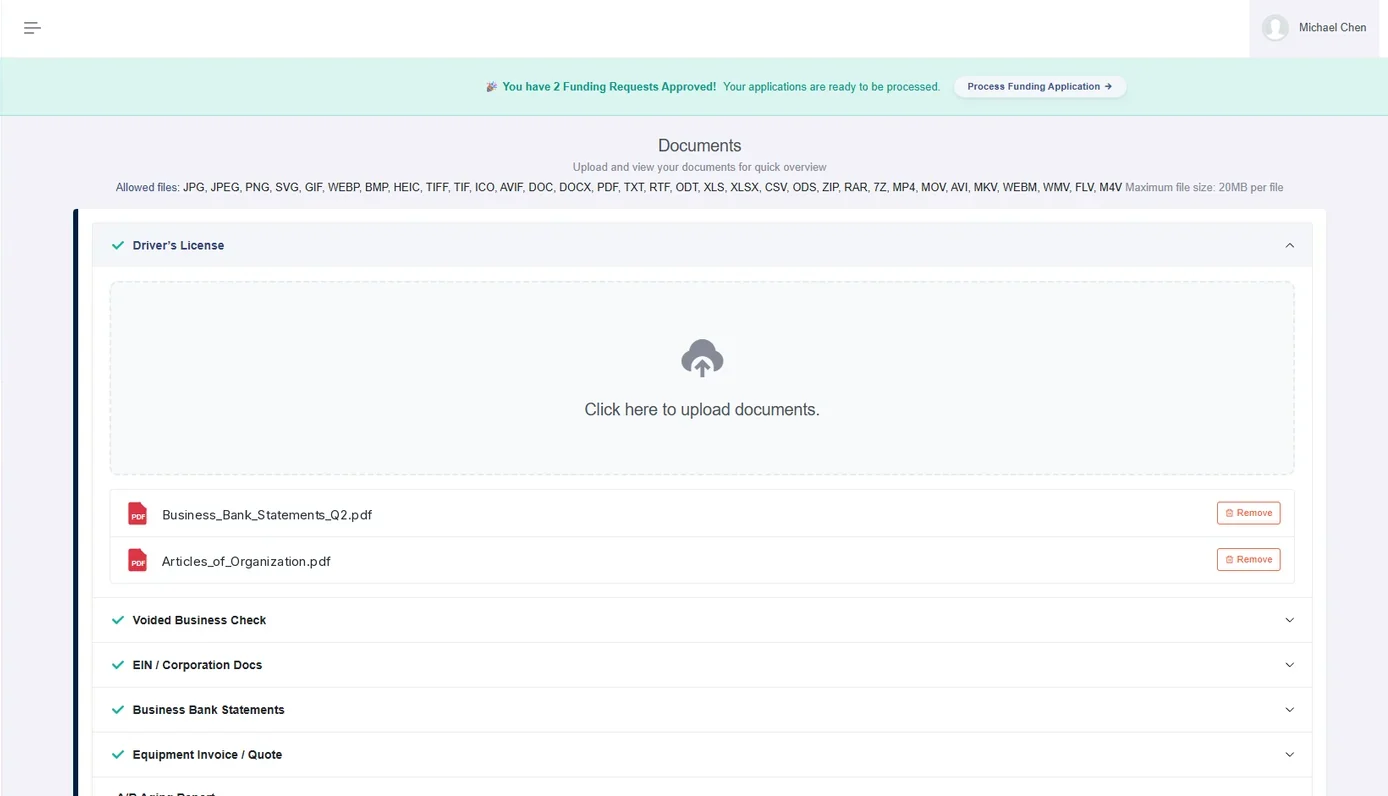
Asking every client for everything is how you get a client who gives up halfway. Asking for exactly what the product in front of them needs — no more — is how you get a complete file on the first pass.
Collect once, use again
The other half of the fix is not asking twice.
A client who uploaded their EIN letter for one application should not be asked for it again three months later for another. Documents that do not change — formation papers, the EIN confirmation, identification — should be collected once and kept. Documents that go stale — bank statements, most obviously — should be the only ones you ask for again, and only when they are out of date.
Clients notice this. Nothing signals disorganisation faster than asking for something they already sent you.
What changes when the chase gets tighter
When the list is exact, product-specific and visible to the client, a few things happen:
- Files complete faster, because nobody is waiting on a round of clarification.
- Files complete more often, because the client can see the finish line.
- Submissions go out clean, because an incomplete file cannot be sent by accident.
- You stop being the bottleneck. The client is not waiting on you to tell them what to do next.
It is the least interesting part of the business to talk about, and it is where the most deals are quietly won or lost.
Four Corner Funding is the DBA and public operating brand of Four Corner Holdings, LLC. This post is general information about operating a commercial finance business. It is not legal, regulatory, tax or financial advice, and it is not a substitute for counsel licensed in your jurisdiction. Illustrative platform view. Fictional companies and synthetic data shown for demonstration. Platform outputs support readiness evaluation and workflow; they are not credit decisions or guarantees of approval.