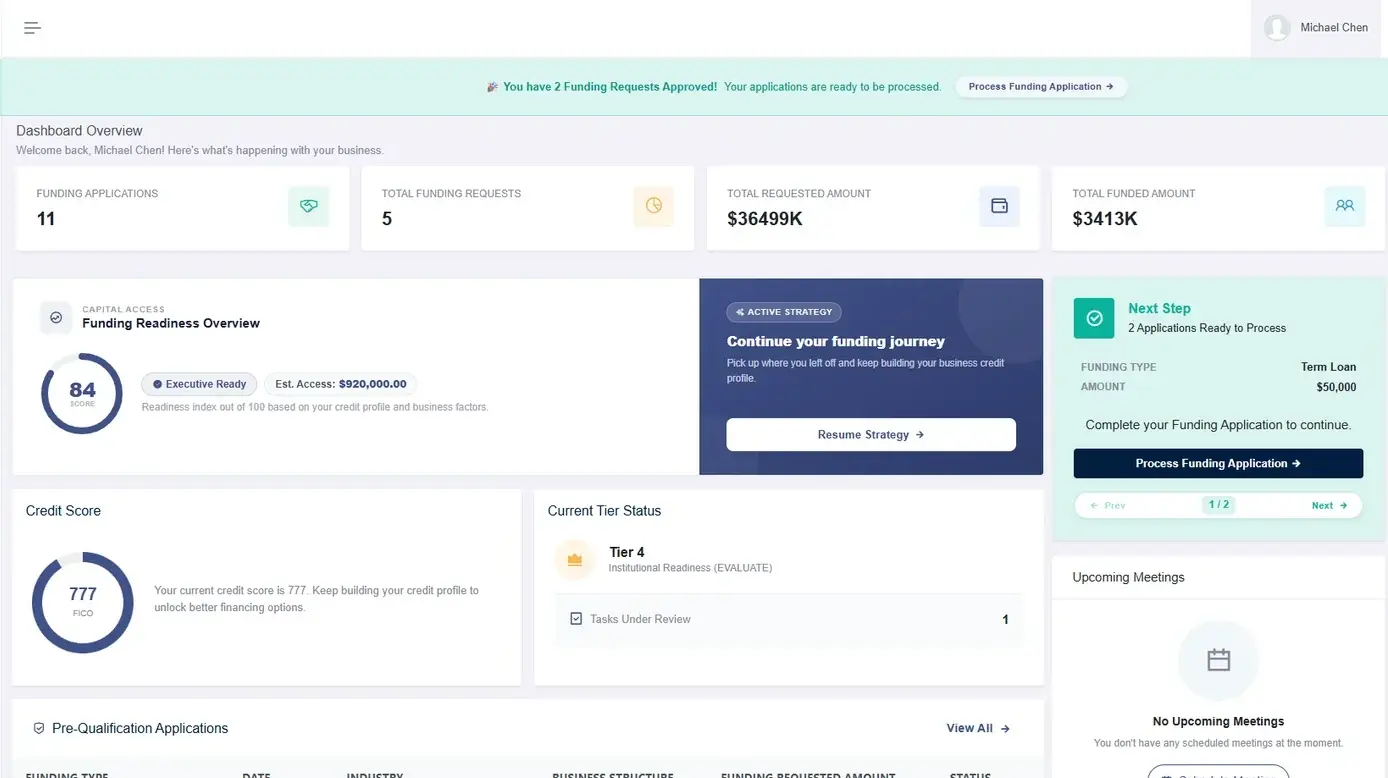

Business Credit Is Built in Tiers, Not All at Once
Sequence matters more than speed. Skip the foundation and every later step works against you — and the aging stage cannot be rushed at all.
Business owners who want capital tend to want it now, and the fastest-sounding advice wins. Open a pile of accounts. Apply for everything. Get the numbers up.
It is almost exactly backwards. A business credit profile is built in a sequence, and the order matters more than the speed. Get the order wrong and each step undermines the one after it.
A note before going further: this is about the business's own credit file — the record the business credit bureaus keep on the company — which is separate from the owner's personal credit. It is business-building, not personal credit repair.
The sequence
Here is how that progression looks laid out as tiers.
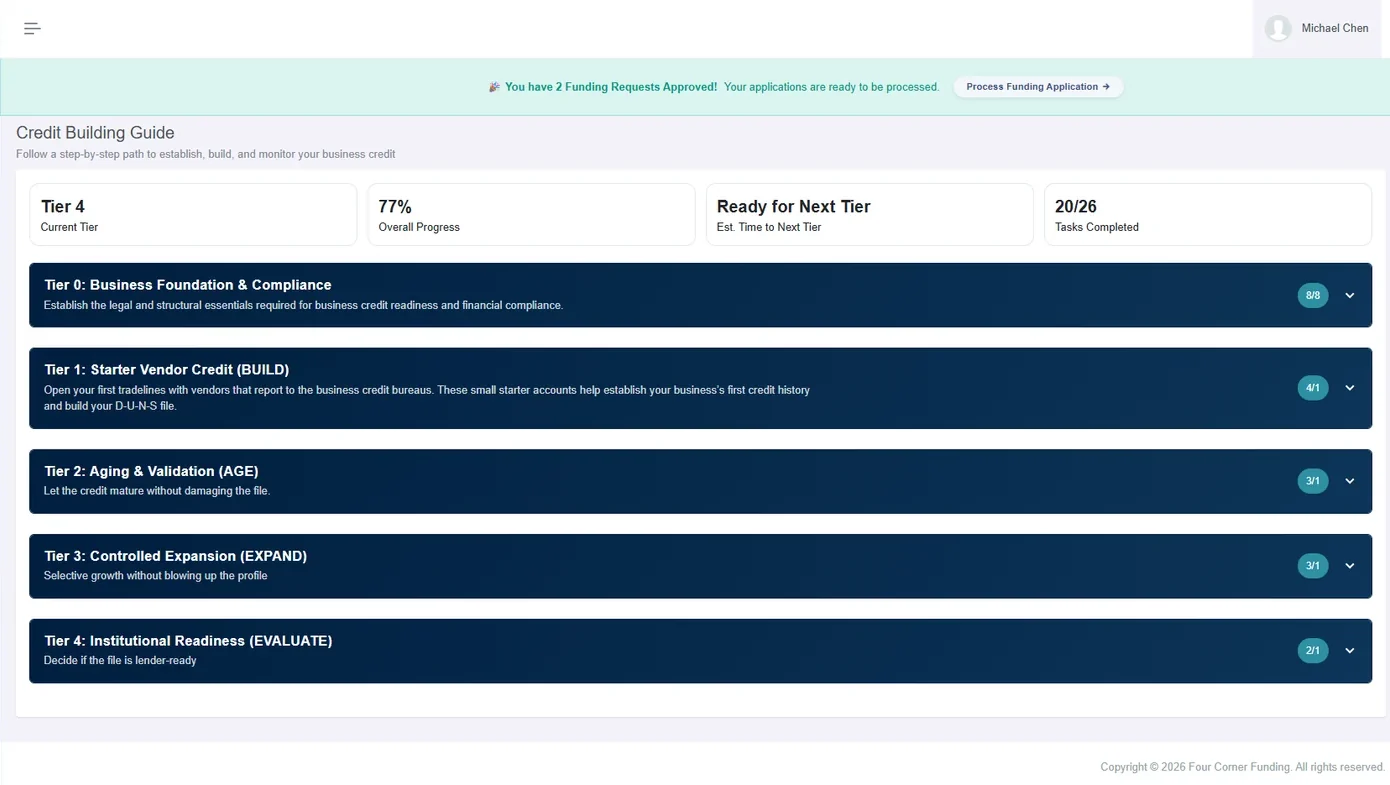
Each tier has one job:
- Tier 0 — Foundation and compliance. Make sure the business is consistent, verifiable and legitimate everywhere it appears.
- Tier 1 — Starter vendor credit (build). Open the first small accounts with vendors that report to the business credit bureaus.
- Tier 2 — Aging and validation (age). Let that credit mature without damaging the file.
- Tier 3 — Controlled expansion (expand). Grow selectively, without overloading the profile.
- Tier 4 — Institutional readiness (evaluate). Decide whether the file is ready for a funding source.
The labels in brackets are the verbs that matter. Build, age, expand, evaluate. They happen in that order for a reason.
Why the foundation comes first
Tier 0 is the one everyone wants to skip, and it is the one that causes the most trouble later.
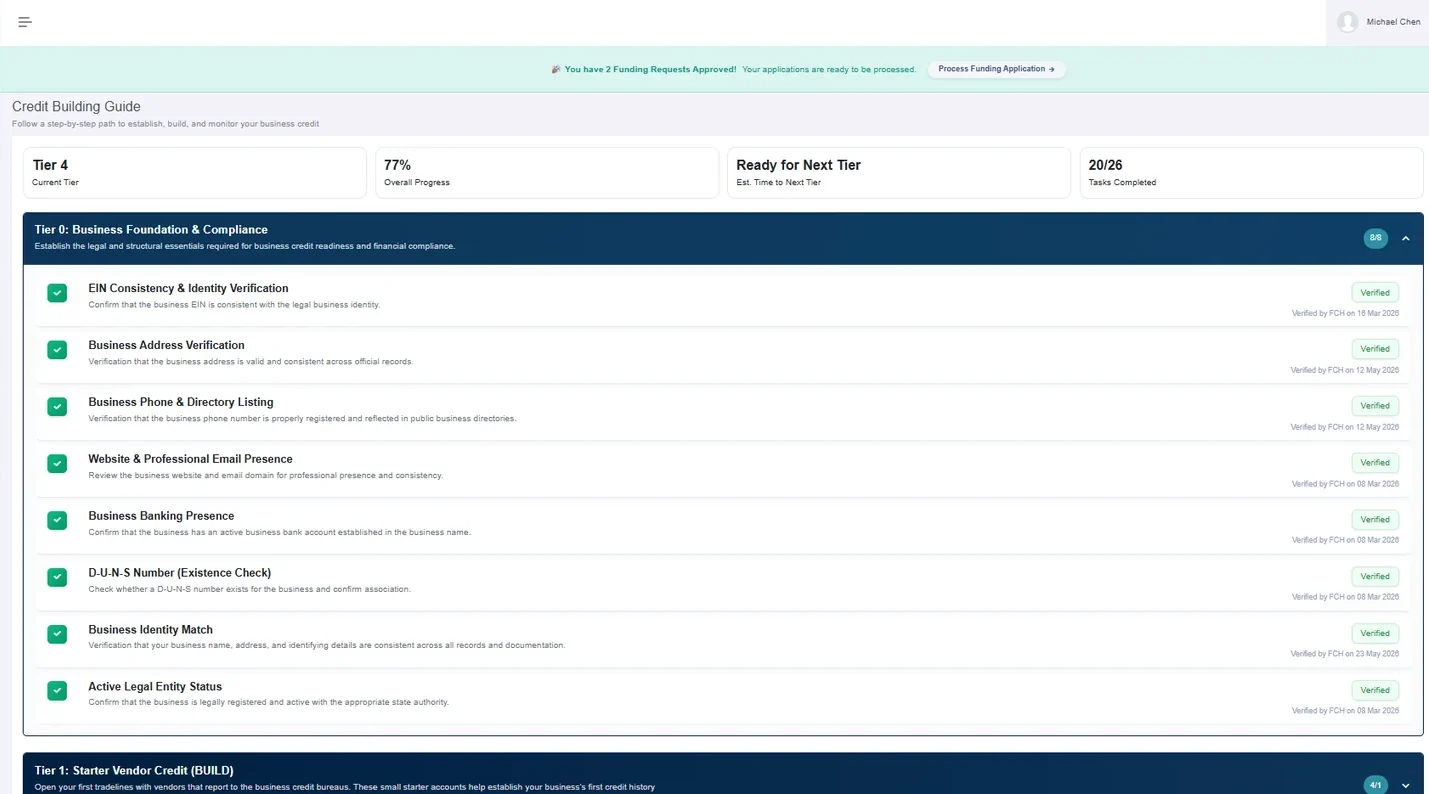
Every item on that list is about consistency. Is the business name the same everywhere? Does the address match across records? Is the phone number listed? Is there a business bank account in the company's name? Is the entity actually in good standing with the state?
When those do not line up, everything built on top inherits the problem. Accounts get reported against slightly different business identities. A funding source's verification turns up a mismatch between the application and the public record. A file that should have been straightforward gets flagged for a reason that has nothing to do with how well the business is performing.
Foundation work is dull, and it is the single cheapest way to avoid a decline later.
Why aging cannot be rushed
Tier 2 is the hardest one for business owners to accept, because the only thing it needs is time.
New credit is thin credit. A profile with several accounts opened in the last sixty days tells a funding source very little about how the business manages obligations over time — and a burst of new accounts can read as a business scrambling for credit rather than one building a history.
There is no shortcut through this stage, and anyone offering one should be treated with suspicion. The right move is to let the accounts report, pay them as agreed, and resist the urge to open more while they mature.
Why expansion is controlled
Tier 3 is where eager owners do damage in the opposite direction: once some credit is established, they apply for everything at once.
Each application leaves a trace, and a cluster of them reads as risk. Controlled expansion means adding credit deliberately, one step at a time, with a reason for each — so the profile grows stronger rather than just longer.
Evaluate before you apply
The last tier is a decision, not an application. Is this file actually ready to go in front of a funding source — or would another sixty days of aging make it materially stronger?
Sometimes the right answer is to wait. That is a hard thing to tell a business owner who wants capital now, and it is the thing that most often separates a clean approval from a decline that stays on the record.
What to tell a business owner
The honest version is short: business credit is built in order, the foundation has to be right before anything else counts, and the middle stage takes time that cannot be bought.
Owners who hear that at the start, and see where they are in the sequence, tend to stick with it. Owners who are promised speed tend to quit at the aging stage — right before it would have started to pay off.
Four Corner Funding is the DBA and public operating brand of Four Corner Holdings, LLC. This post is general information about operating a commercial finance business. It is not legal, regulatory, tax or financial advice, and it is not a substitute for counsel licensed in your jurisdiction. Illustrative platform view. Fictional companies and synthetic data shown for demonstration. Platform outputs support readiness evaluation and workflow; they are not credit decisions or guarantees of approval.