
"Approved" Is Not a Status
A funding file passes through several approvals, and only one of them puts money in the client's account. Tracking the difference is most of the job.
Ask a business owner where their funding stands and you will often hear "it's approved." Ask what that means and the answer gets vague quickly.
That vagueness is not the client's fault. The word gets used for at least four different things in this business, and most brokers use it just as loosely. The result is a client who has already told their landlord the money is coming, and a broker who knows the file is nowhere near funded.
One file, several approvals
Here is a pipeline of funding requests at a glance. Look at the two status columns.
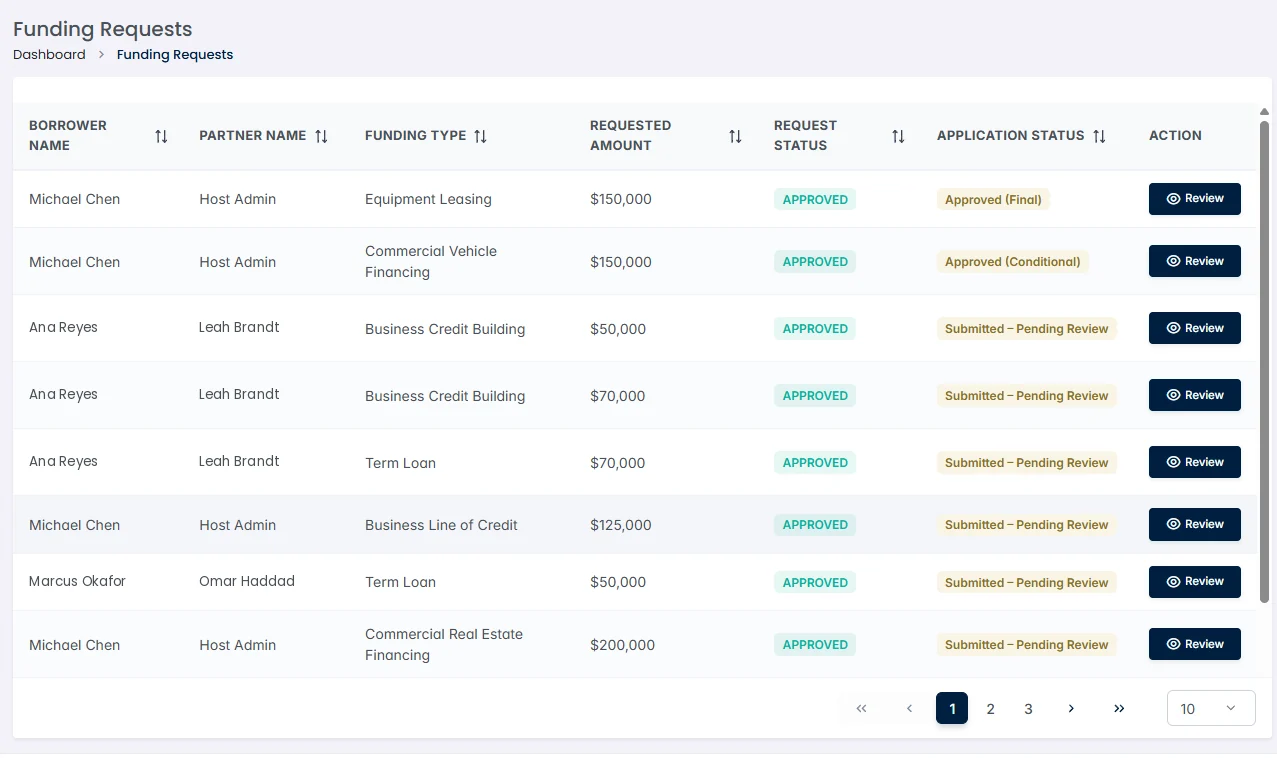
Every request in that list says APPROVED. Most of the applications next to them say Submitted — Pending Review. Two say Approved (Conditional) and Approved (Final).
Those are not contradictions. They are different layers of the same file, and each one answers a different question:
- The request — is this file clean enough, and complete enough, to go forward at all?
- The application — has the funding source looked at it, and what did they say?
- The conditions — what does the funding source still need before they release money?
Collapse them into one word and you lose the only information that matters: what has to happen next, and who has to do it.
What each stage should actually tell you
A useful status answers three things without anyone having to open the file: where it is, how long it has been there, and whose move it is.
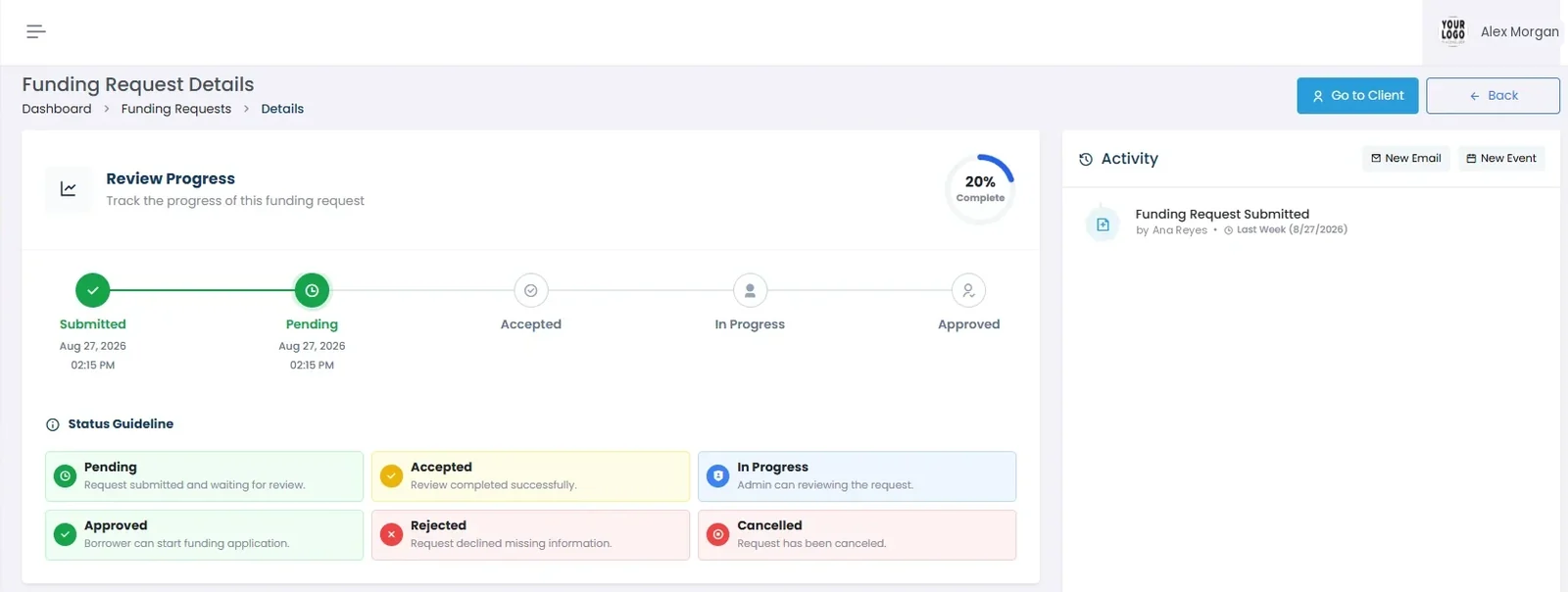
Notice the status guideline in the middle of that screen. Each stage is written down in a sentence:
- Pending — submitted and waiting for review
- Accepted — review completed
- In Progress — being worked
- Approved — the borrower can start the funding application
- Rejected — declined for missing information
- Cancelled — withdrawn
That last definition of Approved is the whole point. At this layer, approved means cleared to apply. It is permission to go to the next step, not a decision about money. An operator who says "you're approved" at this stage is technically correct and practically misleading.
The timestamps under each completed stage do the second job. A file that moved from submitted to pending in the same minute and has sat in pending for eleven days is telling you something. Without the dates, it just looks like a file in pending.
Conditional approval is not a formality
The status that causes the most damage is Approved (Conditional).
A conditional approval from a funding source means yes, if — if the bank verification clears, if the landlord signs a waiver, if the most recent month's statement matches, if the existing position gets paid down. Those conditions are where deals die, and they die quietly, because everyone involved has mentally moved on.
The client hears "approved." The broker hears "approved." Nobody chases the stipulation. Nine days later the offer expires or the numbers move, and the deal is gone.
A conditional approval should be treated as the busiest stage of the file, not the finish line. It needs an owner, a list of exactly what is outstanding, and a date by which each item is due back.
Only one approval pays
Approved (Final) is the funding source's decision, and it is the only one that ends with money in the client's account. Everything before it is a step on the way.
That distinction matters for a practical reason beyond accuracy: it is how you talk to clients without getting burned. Tell a business owner "your request is cleared, and the application is with the funding source now" and they understand exactly where they stand. Tell them "you're approved" three stages early and you have made a promise you do not control.
Funding decisions belong to the funding source. Everything the platform tracks before that point is readiness and workflow — useful, necessary, and not the same thing as a yes.
What this looks like when it works
When statuses are layered and defined, a few things change:
- Clients get accurate updates. You can tell them precisely where the file is and what comes next, which is what they actually want to know.
- Stuck files become visible. A file sitting in one stage for longer than its peers stands out on a list instead of hiding inside a single "in progress" bucket.
- Nobody celebrates early. The team knows the difference between cleared, pending, conditional and final, and works the file accordingly.
None of this requires more effort per file. It requires that the word "approved" stop doing four jobs at once.
Four Corner Funding is the DBA and public operating brand of Four Corner Holdings, LLC. This post is general information about operating a commercial finance business. It is not legal, regulatory, tax or financial advice, and it is not a substitute for counsel licensed in your jurisdiction. Illustrative platform view. Fictional companies and synthetic data shown for demonstration. Platform outputs support readiness evaluation and workflow; they are not credit decisions or guarantees of approval.